
When you start a business, you need a strong online presence. Today, customers search online before they buy a product or contact a service provider. This makes many business owners ask an important question: Should I create a website or a social media page for my business?
Both options can help your business grow. However, they serve different purposes. A social media page helps you connect with people and build engagement. A website gives you more control and provides a central place for customers to learn about your business.
The best choice depends on your goals, budget, and target audience. In many cases, businesses can get better results by using both a website and social media.
What Is a Business Website?
A business website is your own online space. You can use it to explain your business, show your products or services, answer customer questions, and collect enquiries.
A basic business website can include:
- Homepage
- About Us page
- Service or product pages
- Contact page
- Customer reviews
- Blog
- FAQ section
- Enquiry form
You can also add features such as online payments, appointment booking, live chat, and e-commerce.
A website gives you control over your content, design, branding, and customer journey.
What Is a Social Media Business Page?
A social media business page lets you promote your business on platforms such as Instagram, Facebook, LinkedIn, or other social networks.
You can use social media to share updates, photos, videos, offers, customer stories, educational content, and business news.
Social media also allows customers to interact with your brand through comments, messages, reactions, and shares.
It can help you build a community around your business.
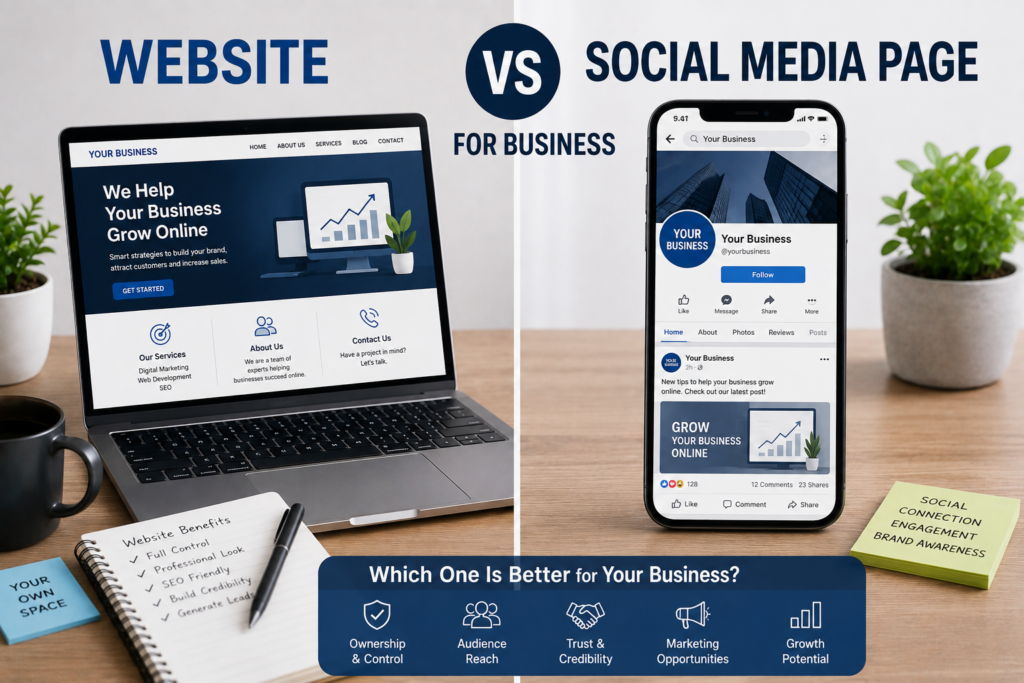
Website vs Social Media Page
Both platforms offer benefits, but they work in different ways.
1. Control
A website gives you more control. You choose the design, content, pages, and features.
Social media platforms control the platform rules, features, and algorithms. They can change how they display your content at any time.
For this reason, a website can provide a more stable home for your business online.
2. Customer Reach
Social media can help you reach people quickly. A useful post or video can reach new users through shares, recommendations, hashtags, and platform algorithms.
A website can attract visitors through search engines, paid advertising, referrals, and other marketing channels.
With SEO, your website can appear when people search for products or services related to your business.
3. Trust and Credibility
A professional website can make your business look more established. Customers can find detailed information about your company in one place.
You can show your services, portfolio, reviews, business information, and contact details.
A social media page can also build trust. However, customers may still visit your website before making an important purchase or contacting your business.
4. Content
Social media works well for short and engaging content. You can share a quick video, image, announcement, or tip.
A website gives you more space for detailed content. You can publish blog posts, guides, case studies, service pages, and FAQs.
For example, you can share a short SEO tip on Instagram and link customers to a detailed SEO guide on your website.
This approach allows both platforms to work together.
5. Customer Communication
Social media makes communication simple. Customers can send direct messages, comment on posts, or react to your content.
A website can provide contact forms, email addresses, live chat, and booking systems.
Social media usually works better for quick conversations and engagement. A website works better when customers need detailed information or want to complete a specific action.
Why Should a Business Have a Website?
A website can become the main online asset for your business.
It can help you:
- Build credibility
- Attract search traffic
- Generate leads
- Display products and services
- Publish useful content
- Collect customer enquiries
- Sell products online
- Control your brand presentation
You also own your website content and can decide how visitors move through your pages.
For businesses that want long-term online growth, a website can provide a strong foundation.
Why Should a Business Use Social Media?
Social media can help businesses connect with their audience on a regular basis.
You can use it to:
- Increase brand awareness
- Share updates
- Promote products
- Engage with customers
- Show behind-the-scenes content
- Share educational posts
- Build a community
- Drive traffic to your website
Social media can also help you understand what your audience likes. You can study comments, shares, views, and other engagement signals.
Is Social Media Enough for a Business?
Some small businesses can operate with only a social media page. This may work for businesses that receive most of their customers through referrals or social platforms.
However, relying only on social media can create limitations.
You do not control the platform. Changes in algorithms can affect your reach. Platform rules can also change. If your account faces a problem, you may lose an important way to communicate with customers.
A website gives you another channel that you can control.
Is a Website Enough?
A website can provide a strong foundation, but you should not ignore social media.
Social media can help bring attention to your brand. You can then direct interested users to your website for more information.
For example, a digital marketing freelancer can post marketing tips on LinkedIn or Instagram. The freelancer can then send interested users to their website to view services, read case studies, or submit an enquiry.
This creates a simple customer journey:
Social Media → Website → Enquiry → Customer
Website and Social Media: The Best Combination
You do not always have to choose between a website and social media.
Using both can create a stronger digital marketing strategy.
Your website can act as the main information and conversion platform. Your social media pages can help you attract attention, communicate with your audience, and promote your website content.
You can also connect the two platforms. Add your website link to your social media profiles and share website articles through your social posts.
Which One Should You Choose?
If you have a limited budget, start with the platform that matches your immediate goals.
If you need a place to explain your services, generate leads, rank on Google, or build long-term online visibility, start with a website.
If you want to build an audience, share content, and communicate with customers regularly, focus on social media.
Ideally, build a simple website and use social media to promote it. You do not need a complicated website at the beginning. Start with the essential pages and add features as your business grows.
Conclusion
The website vs social media page debate does not have to end with one winner. Both platforms serve different purposes.
A website gives your business control, credibility, search visibility, and a central place for customers to take action. Social media helps you connect with people, build engagement, and increase brand awareness.
For most businesses, the strongest approach involves using both. Build a professional website as your online foundation, then use social media to attract and engage your target audience.
When you combine both platforms, you can create a stronger online presence and give customers more ways to discover, trust, and contact your business.